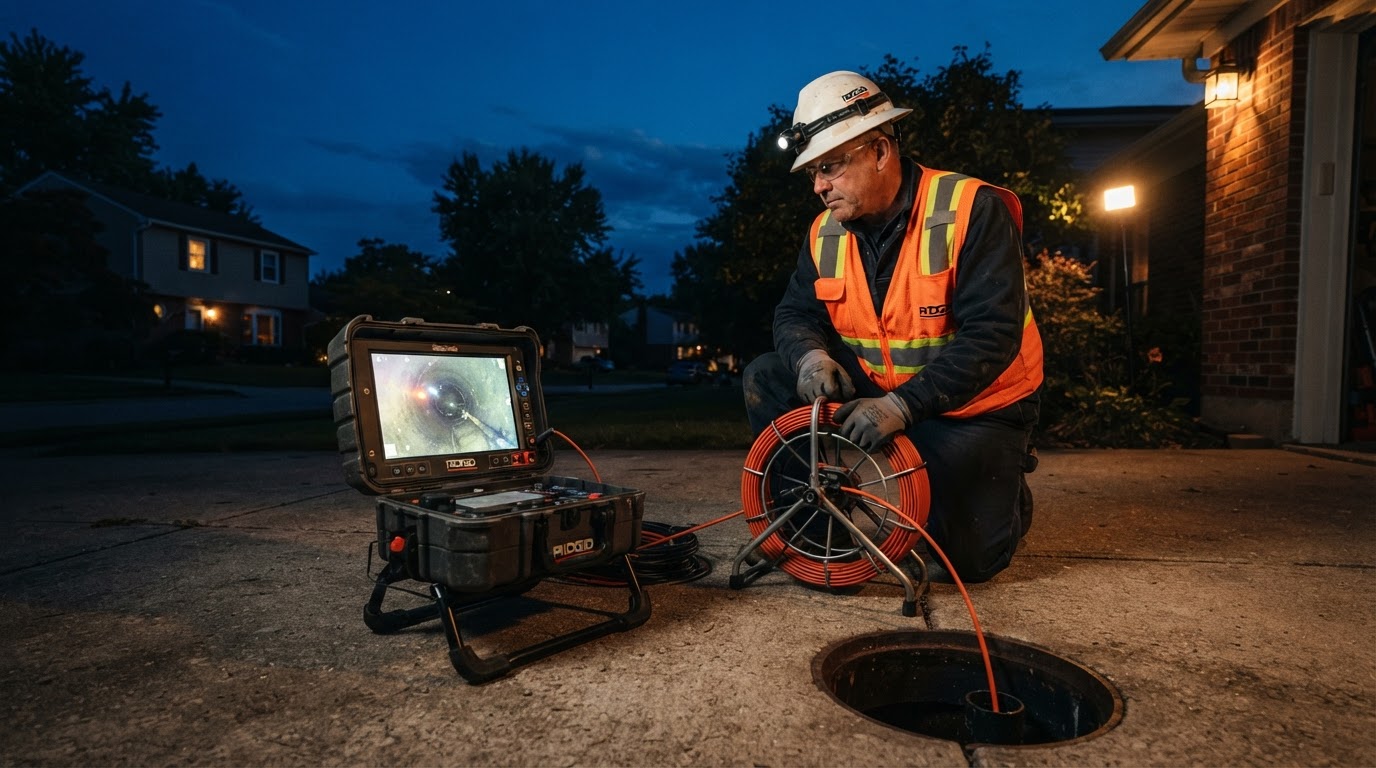
HD Sewer Line Camera Inspection & Video Locating in Cleveland
See the exact crack, root intrusion, or pipe belly on live video before deciding on excavation or lining. The inspection fee is 100% credited toward any repair.
Book Your HD Sewer Line Camera Inspection
100% of the inspection fee is credited toward any repair.
Key Facts
- 100% repair credit toward any lining, jetting, or spot repair
- 512 Hz surface radio sonde depth locating
- Standardized defect assessment following NASSCO PACP principles
- Cleveland Water Pollution Control homeowner lateral ownership rule
What does a sewer line camera inspection show in Cleveland?
We feed a push-rod fiber-optic HD camera through your lateral from the cleanout and watch the live video together, while a 512 Hz surface radio sonde marks the exact depth and location of every crack, root, or belly. The inspection fee is credited 100% toward any repair you book.
What Is an HD Sewer Line Camera Inspection?
An HD sewer line camera inspection is a live video scope of your underground sewer lateral — the pipe that carries wastewater from your home out to the public main. We push a flexible rod tipped with a high-definition, self-leveling fiber-optic camera head through the pipe from your cleanout (a capped access point on your sewer line). As the camera travels, you watch the inside of the pipe in real time on a monitor, so there is no guessing about what is happening underground.
This matters most for Cleveland's older housing stock. Most pre-1960 homes in Cuyahoga County run vitrified clay tile laterals, and clay joints separate as Northeast Ohio's freeze-thaw cycles shift the ground. Cast-iron laterals from the same era scale and corrode from the inside, and some mid-century homes still have Orangeburg pipe, a bituminized fiber pipe that deforms and collapses under soil pressure. None of these failures are visible from the surface — a camera is the only way to see them before they become an emergency.
Because the video gives proof of the exact problem, you avoid digging up a healthy line or authorizing the wrong repair. If you are just starting to research your options, see our homepage overview or our page on emergency and collapsed clay pipe repair.
What Problems Can a Sewer Camera Inspection Detect?
The live video reveals the specific failure inside your lateral. Here are the most common defects we find in Cleveland-area homes:
Tree Root Intrusion
Roots enter through open clay joints and grow inside the pipe, catching debris and blocking flow. The camera shows the exact root ball and how far it extends.
Offset / Separated Clay Joints
Vitrified clay sections shift over decades of freeze-thaw, creating steps where one pipe end drops below the next. The video reveals each offset and its footage mark.
Cracked or Collapsed Walls
Cracks let groundwater in and soil out; a full collapse stops flow entirely. The camera confirms whether the pipe is cracked, fractured, or fully broken.
Standing-Water Bellies
A belly is a sag where the pipe has dropped, letting wastewater pool and collect debris. The video shows standing water and the low point that caused it.
Heavy Grease & Cast-Iron Scale
Grease builds up on the walls and cast-iron pipe flakes into scale that narrows the opening. The camera shows how much of the pipe diameter is lost.
When grease, scale, or roots are blocking the view, we clear them first with high-pressure hydro-jetting so the camera can see the pipe wall clearly.
How Do Homeowners Read a Sewer Camera Report and Defect Codes?
A sewer camera report can look technical, but it follows a simple structure. Here is how to read what you are looking at:
1On-Screen Footage Counter
The video overlay shows how many feet of camera rod have been pushed, so each defect is tied to a distance from the cleanout. A root ball at 38 feet means the problem is 38 feet out — not somewhere vague "in the yard."
212-Hour Clock-Position Defect Locating
Defects are described by their position on a clock face — a crack at 3 o'clock is on the right side of the pipe, a root at 9 o'clock on the left. This tells you exactly where on the pipe wall the problem sits.
3NASSCO PACP Defect Grading
We assess defects following the principles of the NASSCO Pipeline Assessment and Certification Program (PACP), the industry standard for describing pipe conditions consistently. Learn more from NASSCO's PACP certification program.
4512 Hz Surface Sonde Flags & Chalk Depth Markings
A 512 Hz sonde transmitter in the camera head lets us locate the defect from above ground. We flag or chalk-mark the surface spot above each major defect and record its depth, so a future repair targets the exact spot.
When Should You Schedule a Sewer Line Camera Inspection?
A camera scope is the right move whenever you need to know the true condition of a lateral before spending money or signing a contract. Common situations include:
| Situation | Why a Camera Scope Helps | Learn More |
|---|---|---|
| Buying a Pre-1978 Home | Older Cleveland homes often have clay, cast-iron, or Orangeburg laterals. A scope before closing can reveal a failing line so you can negotiate or plan — not discover it after move-in. | Point-of-Sale Scope |
| Recurring Main-Line Backups | If your basement drain or main line backs up repeatedly, the camera finds whether the cause is roots, a belly, or a collapse — instead of guessing and snaking again. | Hydro-Jetting Service |
| Second Opinion Before Trench Excavation | Before you authorize an open-trench dig across your yard, a camera scope confirms the failure is real and shows whether a trenchless repair is possible. | Cost & Pricing Guide |
| Post-Cleaning Verification | After hydro-jetting or a repair, we re-scope the line on camera to confirm it is fully open, smooth, and free of defects before we pack up. | Hydro-Jetting Service |
How Does the Camera Inspection Fee Compare to Repair Credit?
A standalone diagnostic scope covers the technician's dispatch, the live HD video recording, surface depth locating with the 512 Hz sonde, and a digital video copy you keep. We confirm the scope and access on site rather than quoting a fixed dollar figure blindly, because cleanout location and pipe length vary from home to home.
Here is the part homeowners appreciate: if you book any repair or hydro-jetting with us, 100% of the inspection fee is credited toward that repair invoice. In other words, the diagnostic costs you nothing when you move forward with the fix — you only pay the inspection if you do no further work.
What the standalone scope includes
- Dispatch to your Cleveland-area property
- Live HD video recording of the full lateral
- 512 Hz surface depth locating and marking
- Digital video copy and written condition report
See your sewer line on live video first.
HD camera inspection — 100% credited toward any repair. Call now to book your scope across Cuyahoga County.
What Should Cleveland Homeowners Know Before a Camera Inspection?
In Cleveland and most of Cuyahoga County, the property owner — not the city — owns and maintains the sewer lateral from the home out to the public main. Cleveland Water Pollution Control explains this in their homeowner FAQ, and the Northeast Ohio Regional Sewer District describes how the regional conveyance and sewer system works. Always confirm the exact responsibility boundary with your local municipality.
To get the clearest video, a little prep helps. Follow this simple checklist before we arrive:
- Clear about 3 feet of space around your basement cleanout so we can access it and feed the camera.
- If the line is actively backed up, let us know — standing water may need clearing before a clear video is possible.
- Never pour chemical drain openers before we open the cleanout; they can splash back and make the area unsafe to scope.
Sewer Camera Inspection in Cleveland — FAQ
See your sewer line on live video first.
HD camera inspection — 100% credited toward any repair. Call now to book your scope across Cuyahoga County.
Sources & References
- NASSCO — PACP Certification Program
- Cleveland Water Pollution Control — Homeowner FAQ
- NEORSD — Conveyance & The Sewer System
Trenchless CIPP lining and pipe bursting often require minimal or no yard or driveway excavation, with many lining jobs completed in about a day depending on pipe condition and access.