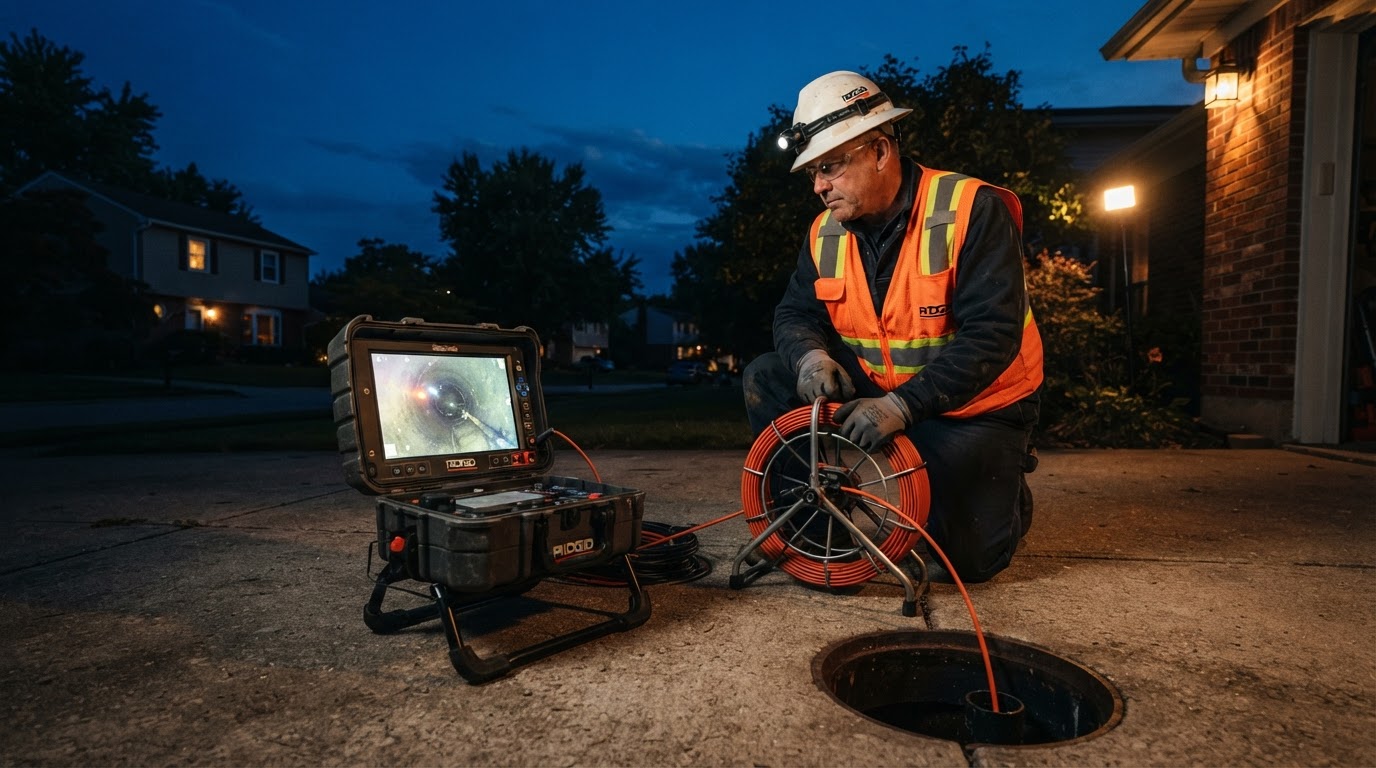
Trenchless Sewer Line Replacement Cost Factors in Cleveland
Understand exactly what drives the price of lining, pipe bursting, and open-trench replacement — before you approve any work.
Request Your Itemized Camera Scope & Repair Quote
100% of the inspection fee is credited toward any repair.
Key Facts
- Itemized quotes start with an HD camera inspection credited 100% toward repair
- Linear footage, pipe depth, and root cleaning drive total cost
- Surface restoration savings often make trenchless lower total cost than digging
- NEORSD income-eligible repair assistance available for qualifying Cleveland owner-occupants
What determines trenchless sewer replacement cost in Cleveland?
Total cost depends on your lateral's length in linear feet, its burial depth, whether pre-lining hydro-jetting or descaling is needed, how many branch wye connections must be reinstated, the cleanout access available, and whether CIPP lining, pipe bursting, or open-trench digging is the right method. Every quote starts with an HD camera inspection credited 100% toward repair.
Why Do Cleveland Sewer Line Repair Quotes Vary From House to House?
A sewer lateral is the buried pipe that carries wastewater from your home to the public main under the street. Because it is underground, no honest contractor can quote it sight-unseen. Two houses on the same block can face completely different jobs: one may have a shallow 40-foot clay lateral with a cleanout right at the failure, while the next has an 80-foot deep cast-iron line under a shared driveway with a collapsed section in the middle.
That is why every legitimate quote starts with an HD sewer camera inspection. The camera measures the actual linear footage, confirms the burial depth with sonde locating, identifies the pipe material, and shows whether the pipe is cracked, root-filled, bellied, or collapsed. Only after that video can a contractor write an itemized quote that reflects the real work — and the inspection fee is credited 100% toward any repair you book, so the diagnostic costs you nothing when you move forward.
Be cautious of any quote given over the phone without a camera inspection. It is either a generic range that will change on site, or it is priced high to protect the contractor against the unknown. The video-first approach protects you: you see the defect, the footage mark, and the depth before any number is written down.
What Are the 6 Main Cost Drivers of Trenchless Sewer Replacement?
When you receive an itemized quote, these six factors explain nearly every line in it. Understanding them helps you see exactly where your money goes:
1. Total Linear Footage
The distance from your house to the street main, measured in linear feet, determines how much liner material, jetting time, and labor the job needs. A camera inspection measures your actual footage so the quote reflects your pipe — not a neighborhood average.
2. Pipe Burial Depth
Laterals in Cuyahoga County often run 8 to 14 feet deep. Deeper pipes mean deeper access pits, more shoring, and more careful excavation — whether the job is trenchless or open-trench. Depth is confirmed during the camera scope with sonde locating.
3. Pre-Lining Root Removal & Descaling
Before a liner can be installed, roots and cast-iron scale must be cleared so the liner bonds to a clean wall. This hydro-jetting prep step is priced separately from the lining itself and depends on how heavy the intrusion is.
4. Branch Wye Connections
Every branch line that ties into the main lateral — a floor drain, a laundry line, a bathroom stack — creates a wye connection. After lining, each connection must be robotically reinstated so it is not sealed over. More branches mean more reinstatement work.
5. Cleanout Installation & Access Pits
Trenchless methods still need access. If your home has no exterior two-way cleanout, one may need to be installed, and small access pits at each end of the liner are part of the job. Existing cleanouts reduce this cost.
6. Municipal Permits
Most Cuyahoga County municipalities require building permits for sewer lateral work, and street-opening permits apply if work extends past the curb. Permit fees and inspection requirements vary by city and are a real line item in any honest quote.
How Do CIPP Lining, Pipe Bursting, and Open-Trench Excavation Compare on Total Value?
Trenchless methods often require minimal or no yard or driveway excavation, with many lining jobs completed in about a day depending on pipe condition and access. But trenchless is not always the right answer — the table below shows when each method wins, including the cases where open-trench digging is genuinely the better choice.
| Method | Upfront Installation Scope | Restoration Impact | When Each Method Is Better | Design Standard |
|---|---|---|---|---|
| CIPP Pipe Lining | A resin-saturated felt liner is pulled or inverted into the existing pipe and cured in place, creating a jointless new pipe inside the old one. | Minimal — typically one or two small access pits. Driveways, porches, and landscaping are usually left intact. | Cracks, separated clay joints, and root intrusion in a pipe that is still round enough to accept a liner. | Designed to the NASSCO 50-year standard for cured-in-place rehabilitation. |
| Pipe Bursting | A bursting head breaks the old pipe outward while a new HDPE pipe is pulled through the same path behind it. | Minimal — access pits at each end. Surface restoration is usually limited to those small openings. | Laterals too deformed, collapsed, or out-of-round to accept a liner, where the pipe path can be reused. | New HDPE pipe is designed for a 50-year service life under the same NASSCO rehabilitation standards. |
| Open-Trench Excavation | The failed section is dug up with an excavator, removed, and replaced with new pipe laid at the correct grade. | Significant — the trench is backfilled and the driveway, sidewalk, porch, or landscaping above it must be restored. | Severely collapsed sections, deep negative-slope bellies, or laterals that need a completely new path and grade. | New pipe installed at proper grade; lifespan depends on the pipe material chosen. |
The honest takeaway: when a pipe is severely collapsed or has a deep negative-slope belly, open-trench excavation is the better choice because the new pipe must be laid at the correct grade — no liner can fix a pipe that has lost its shape. If your video shows a collapse, see our emergency and collapsed clay pipe repair page for what happens next.
What Hidden Costs Should Homeowners Watch For When Comparing Quotes?
The difference between two quotes is often not the headline number — it is what each quote quietly leaves out. Watch for these five commonly overlooked items:
Exterior two-way cleanout installation
If your home lacks an exterior cleanout, adding one is often required for access — and it is a separate line item some quotes leave out.
Concrete driveway, sidewalk, or porch replacement
Open-trench digging cuts through hardscape. Restoration of concrete and masonry is frequently quoted separately or omitted entirely.
Municipal permit and inspection fees
Building permits and street-opening permits carry fees that vary by city. Ask whether the quote includes them.
Post-repair camera verification video
A final camera pass confirming the repair is complete and defect-free should be included — ask whether it is.
Traffic control or street-opening bonds
If work extends past the curb into the right-of-way, some municipalities require bonds or traffic control measures.
These costs vary by suburb, too. Lakewood's narrow shared driveways and tight lot lines make restoration especially expensive if digging is involved — see our Lakewood trenchless repair page. Parma's deep post-war laterals and Orangeburg pipe failures change the calculation in a different direction — see our Parma sewer line replacement page.
How to Compare Sewer Contractor Quotes Apples-to-Apples
Before you sign anything, run both quotes through this six-point checklist. If a contractor cannot answer one of these questions, that is your answer about the quote.
The 6-point quote checklist
- 1Insist on a digital copy of the HD camera footage — you should be able to see the defect yourself.
- 2Verify the linear footage the quote is based on, measured from the camera run, not estimated.
- 3Confirm the resin or HDPE material specifications, including thickness and design standard.
- 4Check whether municipal building and street-opening permits are included in the price.
- 5Verify the written warranty terms — what is covered, for how long, and in writing.
- 6Confirm the camera inspection fee is credited toward the repair invoice.
Get an itemized quote based on live video — not a guess.
HD camera inspection — 100% credited toward any repair. Call now to book your scope across Cuyahoga County.
Financing, Homeowner Service-Line Insurance & Cleveland Assistance Programs
Sewer lateral repairs are one of the most common surprises in homeownership, and there are three funding paths worth knowing about before you need them.
Standard homeowners insurance
Standard homeowners policies typically exclude gradual wear and tear and tree root intrusion — the two most common causes of lateral failure. Sudden, accidental damage may be covered, but a slowly failing clay lateral usually is not. Read your policy declarations to see what is excluded.
Optional service-line endorsements
Many insurers offer an optional service-line endorsement that adds coverage for buried water and sewer laterals. If you do not have one, ask your agent what it costs — for homes with aging clay or cast-iron laterals, it can be worth pricing out.
NEORSD Cost-Saving Plumbing Repair Program
The Northeast Ohio Regional Sewer District offers a Cost-Saving Plumbing Repair Program that can provide income-eligible assistance for qualifying Cleveland owner-occupants facing lateral repairs. Review the program requirements on NEORSD's official site to see whether you qualify. Cleveland Water Pollution Control also answers common homeowner questions in its FAQ.
Trenchless Sewer Replacement Cost in Cleveland — FAQ
Get an itemized quote based on live video — not a guess.
HD camera inspection — 100% credited toward any repair. Call now to book your scope across Cuyahoga County.
Sources & References
- NASSCO — Pipe Rehabilitation Standards
- Cleveland Water Pollution Control — Homeowner FAQ
- NEORSD — Conveyance & The Sewer System
- NEORSD — Cost-Saving Plumbing Repair Program
Trenchless CIPP lining and pipe bursting often require minimal or no yard or driveway excavation, with many lining jobs completed in about a day depending on pipe condition and access.